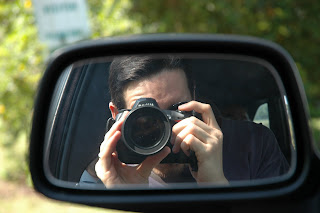
Monday, January 3, 2011
Best of 2010
I have found it is good to stop every now and then for a little reflection. Inspired by a photographer friend, I had a look through my photos from last year and picked out some of my favourites. So without further ado, my personal best photos of 2010: (click on each photo to see it larger)


Sunday, August 22, 2010
Light painting as a kids' camp elective
During the winter holidays this year, I was a leader on a camp for high school students called Übertweak Winter 2010. Actually, there are several Übertweak camps each year. They're all computer camps run under the Scripture Union umbrella. I used to lead on Übertweak many years ago, but took a break for a few years while living in Mackay.
 On this year's camp, I ran an elective about digital photography. It was run at night, which gave us an opportunity to try some clever tricks with light painting. The idea of light painting is to keep the camera still while you move some light around within the frame, literally painting a picture with the shutter held open. The key is to remember that the camera sees—and captures—light, for as long as the film (or sensor, in a digital camera) is exposed. Dark things like a person behind a torch don't actually get seen, but the light shining out of the torch at the camera—ah, that will make a bright spot, or a streak if the torch is moved around.
Of course, you can do more than just draw diagrams. If you put a person into the picture, you can stand behind them with your torch, and create a fabulous silhouette effect, literally wrapping them in light. You just have to keep the torch properly behind the subject's body, otherwise you'll get a very bright spot where the camera could actually see the torch itself.
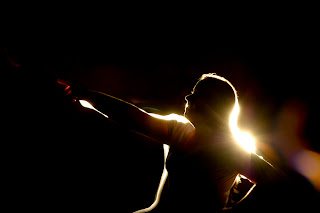 The hardest part of doing this is managing to stand still enough during the exposure. You need a camera that can give you a nice long exposure. Most SLRs have a B setting, for “bulb” (it's called that for historical reasons); if you have a cable release that's even better, as it means you don't move the camera when you press the button. If don't have a cable release with a lock, you'll need an extra helper to hold the button down. Alternatively, you may be able to ask your camera to give you nice long exposure, say thirty seconds or even two minutes. You'll probably want a medium to small aperture (f/8 or higher) to ensure you don't get stray light on the background showing up. And of course, if it's a digital camera, you can check the result right away, and have another go if you don't like what you see.
We also had some fun making ghosts, but I can't show you any of those, because the campers are all recognisable in them. Or, wait, maybe I can, if I block out their faces.
 To make a photo like this, the “ghost” just has to leave half-way through the long exposure. The longer they stay there, the more solid they look. Make a test shot first, and adjust the camera's aperture so that the finished image is exposed correctly for your long shutter time.
On the last elective night, we made a group portrait out on the oval. Our “light” in this case was a hand-held laser. Who needs a flash?
 (I'm the one on the left, next to me is my fellow elective leader Kyle.)
 This work by Ian Bailey-Mortimer is licensed under a Creative Commons Attribution-Noncommercial-Share Alike 2.5 Australia License.
Permissions beyond the scope of this license may be available by request.

Of course, you can do more than just draw diagrams. If you put a person into the picture, you can stand behind them with your torch, and create a fabulous silhouette effect, literally wrapping them in light. You just have to keep the torch properly behind the subject's body, otherwise you'll get a very bright spot where the camera could actually see the torch itself.

We also had some fun making ghosts, but I can't show you any of those, because the campers are all recognisable in them. Or, wait, maybe I can, if I block out their faces.

On the last elective night, we made a group portrait out on the oval. Our “light” in this case was a hand-held laser. Who needs a flash?
 This work by Ian Bailey-Mortimer is licensed under a Creative Commons Attribution-Noncommercial-Share Alike 2.5 Australia License.
Permissions beyond the scope of this license may be available by request.
Saturday, May 8, 2010
Thursday, April 1, 2010
Serendipitous light-box fun
A friend had a birthday party last weekend at Casablanca, where he had reserved the downstairs area. It was a masquerade, so because I knew everyone would be dressed up all fancy, I took my good camera along.


Towards the end I happened to spot a little alcove with a bench seat and white walls all around, and I thought, a-ha! some bounced flash fun here for sure! And indeed, with a little help from others holding flash and (for my self-portrait) camera, I did manage to make a few lovely portraits.


I've learnt that in these situations I need to increase the exposure quite a bit. My camera (a Nikon D70s) tends to under-expose flash photos—well, actually, it tends to expose so that the highlights are dead on 50%. This looks fine in many situations, but for nice portraits it's way too dark. But I really like the instant feedback of digital photography: I just set it on manual, chose a flash power a bit below maximum (I think these were at about 1/4), and adjusted the aperture until it looked right.
This work by Ian Bailey-Mortimer is licensed under a Creative Commons Attribution-Noncommercial-Share Alike 2.5 Australia License.
Permissions beyond the scope of this license may be available by request.
Towards the end I happened to spot a little alcove with a bench seat and white walls all around, and I thought, a-ha! some bounced flash fun here for sure! And indeed, with a little help from others holding flash and (for my self-portrait) camera, I did manage to make a few lovely portraits.
I've learnt that in these situations I need to increase the exposure quite a bit. My camera (a Nikon D70s) tends to under-expose flash photos—well, actually, it tends to expose so that the highlights are dead on 50%. This looks fine in many situations, but for nice portraits it's way too dark. But I really like the instant feedback of digital photography: I just set it on manual, chose a flash power a bit below maximum (I think these were at about 1/4), and adjusted the aperture until it looked right.
This work by Ian Bailey-Mortimer is licensed under a Creative Commons Attribution-Noncommercial-Share Alike 2.5 Australia License.Permissions beyond the scope of this license may be available by request.
Sunday, November 8, 2009
Schmap Brisbane Guide
One of my photos has been included in the latest (ninth) edition of the Schmap Brisbane Guide! You can see it here.
Sunday, August 16, 2009
Weekend Landscapes
DPS had a Weekend Landscape Photography Challenge this weekend. So I went for a drive this afternoon and took a few photos. Here's what I came up with.
This work by Ian Bailey-Mortimer is licensed under a Creative Commons Attribution-Noncommercial-Share Alike 2.5 Australia License.
Permissions beyond the scope of this license may be available by request.
had a Weekend Landscape Photography Challenge this weekend. So I went for a drive this afternoon and took a few photos. Here's what I came up with. This work by Ian Bailey-Mortimer is licensed under a Creative Commons Attribution-Noncommercial-Share Alike 2.5 Australia License.Permissions beyond the scope of this license may be available by request.
Sunday, August 2, 2009
Why bother taking photos?
I asked my friend Allison a few tricky questions about her poetry, because she was looking for things to blog about. In answering my questions, Allison turned the tables and has asked me a few in turn. Let's see whether I can give suitable answers.
If I don't have my camera with me (gasp!) I'll use my new camera-phone, or plan a return trip. I have even been known to plan well ahead for some photos (weeks or even months). There's a particular picture I have in my head, or a place I've been more than once but don't feel I've yet captured the essence of, or a new technique I want to try.
1. Visual. Look. Look again more carefully. What do I want to capture, and what is a distraction? Now put camera to eye. Do I like what I see? Adjust position and zoom until I do—or put the camera away and forget about it.
2. Technical. Is the camera in the right mode? Will the default/current settings work for the effect I want? Adjust as necessary.
3. Review. Shoot. Check preview on back of camera. Don't like it? Try again from step 1—or give up if unsuccessful more than two or three times.
4. Review again. After a break (e.g. once downloaded onto computer or developed), review the image again. Did I capture what I wanted? Does it take me straight back to where I was when I took it? Is it technically well-executed? Would Laetitia like it? If the end result is no good, plan another trip to try again. But think some more about what to try differently before then.
Notice that only step 3 has changed since I switched to digital. I used to routinely take two or three different approaches to every photo (who am I kidding? I still do—old habits die hard I guess) because I had to wait days or weeks before I could see the results. Now with digital I can reject bad ideas that much sooner.
And there's a lot of reflection in there. I grew up on film, which gets expensive. Every frame counts.
Until recently I was predominantly a landscape/nature photographer. My early work shows this bias very heavily. But I've been trying to branch out.
Abstract I think I have a good handle on; it's how my brain thinks most of the time anyway. My portraits are gradually improving since I decided to work on them as a special focus. Research on Strobist and a new external flash are helping to stretch my skills. Flash photography is one of the technical areas I still have to think through very carefully—available light being the only real possibility for landscape photography, I'm not yet familiar with how to use flash well. But I'm learning.
Black & whites I think I used to do better when I used film. There's something about having a black & white film in the camera that really makes me think about what will work and what won't. With a digital camera it's too easy to think, just take colour photos and convert them later. But that doesn't work nearly as well. Same with changeable ISO settings. Having a roll of film that's hard to swap makes me more creative with how I take photos, to use what I've got to make a good image. (And remember, with film, every frame costs.)
But what else? Landscapes and a sense of place I think I'm good at. I love exploring the beauty of musical instruments—mine and everyone else's. I've been dipping into the delicious world of digital infrared. But there's still way more things to try…
Bonus funny story: Before I discovered Flickr, I thought I was somehow unusual because I occasionally liked taking odd self-portraits. I had an epiphany when I discovered the 365 Days project!
I take photos because I have to. I know that sounds like a cliché, what every creative artist says. I see something I like, and I just have this urge to capture it with a camera and share it. Sometimes because it's aesthetically pleasing. Sometimes because it's a technical challenge, and I'm a born problem-solver. But always because I have to, to satisfy something deep inside. I love making still images that capture a moment, a feeling, a place, an idea. And especially if by doing so I can reflect a little of God's glory back to him. He's a fabulous artist!


My professional reading leads me to many more ideas. Strobist and DPS keep me connected to new ideas all the time, the former on flash and portraits (my current focus—pun intended) and the latter more generally.
And finally, my wife. Laetitia learnt how to be a good photographer through my lending her a camera many years ago and telling her to practice. But her approach is not like mine at all; her mind's eye sees things differently, and sees different things. If we both enter a photo competition, she'll win every time, I think because her vision is more conventional. I tend to see odd and unusual angles, that may make people uncomfortable and certainly aren't everyone's cup of tea. I may be technically more skilful, but her photos have greater mass appeal.
Allison, thanks for asking. I hope these answers satisfy some of your curiosity!
This work by Ian Bailey-Mortimer is licensed under a Creative Commons Attribution-Noncommercial-Share Alike 2.5 Australia License.
Permissions beyond the scope of this license may be available by request.
- Inspiration. What inspires you to take your camera out to take a shot?
If I don't have my camera with me (gasp!) I'll use my new camera-phone, or plan a return trip. I have even been known to plan well ahead for some photos (weeks or even months). There's a particular picture I have in my head, or a place I've been more than once but don't feel I've yet captured the essence of, or a new technique I want to try.
- Construction. How do you go about composing a photo as you take it? How do you get from there's-this-idea-in-my-head to ah-what-a-nice-finished-photo?
1. Visual. Look. Look again more carefully. What do I want to capture, and what is a distraction? Now put camera to eye. Do I like what I see? Adjust position and zoom until I do—or put the camera away and forget about it.
2. Technical. Is the camera in the right mode? Will the default/current settings work for the effect I want? Adjust as necessary.
3. Review. Shoot. Check preview on back of camera. Don't like it? Try again from step 1—or give up if unsuccessful more than two or three times.
4. Review again. After a break (e.g. once downloaded onto computer or developed), review the image again. Did I capture what I wanted? Does it take me straight back to where I was when I took it? Is it technically well-executed? Would Laetitia like it? If the end result is no good, plan another trip to try again. But think some more about what to try differently before then.
Notice that only step 3 has changed since I switched to digital. I used to routinely take two or three different approaches to every photo (who am I kidding? I still do—old habits die hard I guess) because I had to wait days or weeks before I could see the results. Now with digital I can reject bad ideas that much sooner.
And there's a lot of reflection in there. I grew up on film, which gets expensive. Every frame counts.
- Editing. Do you edit as you go with digital images? Do you take a lot of photos, then edit after?
- Style. How do you feel about particular styles of photographs - black and white, portraits, abstract (Have you tried them all?)
Until recently I was predominantly a landscape/nature photographer. My early work shows this bias very heavily. But I've been trying to branch out.
Abstract I think I have a good handle on; it's how my brain thinks most of the time anyway. My portraits are gradually improving since I decided to work on them as a special focus. Research on Strobist and a new external flash are helping to stretch my skills. Flash photography is one of the technical areas I still have to think through very carefully—available light being the only real possibility for landscape photography, I'm not yet familiar with how to use flash well. But I'm learning.
Black & whites I think I used to do better when I used film. There's something about having a black & white film in the camera that really makes me think about what will work and what won't. With a digital camera it's too easy to think, just take colour photos and convert them later. But that doesn't work nearly as well. Same with changeable ISO settings. Having a roll of film that's hard to swap makes me more creative with how I take photos, to use what I've got to make a good image. (And remember, with film, every frame costs.)
But what else? Landscapes and a sense of place I think I'm good at. I love exploring the beauty of musical instruments—mine and everyone else's. I've been dipping into the delicious world of digital infrared. But there's still way more things to try…
Bonus funny story: Before I discovered Flickr, I thought I was somehow unusual because I occasionally liked taking odd self-portraits. I had an epiphany when I discovered the 365 Days project!
- Why do you take photos anyway? Aren't there enough starving photographers in the world already?
I take photos because I have to. I know that sounds like a cliché, what every creative artist says. I see something I like, and I just have this urge to capture it with a camera and share it. Sometimes because it's aesthetically pleasing. Sometimes because it's a technical challenge, and I'm a born problem-solver. But always because I have to, to satisfy something deep inside. I love making still images that capture a moment, a feeling, a place, an idea. And especially if by doing so I can reflect a little of God's glory back to him. He's a fabulous artist!
- Is there a photo you have seen that someone else has taken that has inspired you and how you take photographs?
My professional reading leads me to many more ideas. Strobist and DPS keep me connected to new ideas all the time, the former on flash and portraits (my current focus—pun intended) and the latter more generally.
And finally, my wife. Laetitia learnt how to be a good photographer through my lending her a camera many years ago and telling her to practice. But her approach is not like mine at all; her mind's eye sees things differently, and sees different things. If we both enter a photo competition, she'll win every time, I think because her vision is more conventional. I tend to see odd and unusual angles, that may make people uncomfortable and certainly aren't everyone's cup of tea. I may be technically more skilful, but her photos have greater mass appeal.
Allison, thanks for asking. I hope these answers satisfy some of your curiosity!
This work by Ian Bailey-Mortimer is licensed under a Creative Commons Attribution-Noncommercial-Share Alike 2.5 Australia License.Permissions beyond the scope of this license may be available by request.
Subscribe to:
Posts (Atom)